
Post-Quantum Cryptography Migration: A Practical 2026 Action Plan for Enterprise Security Architects

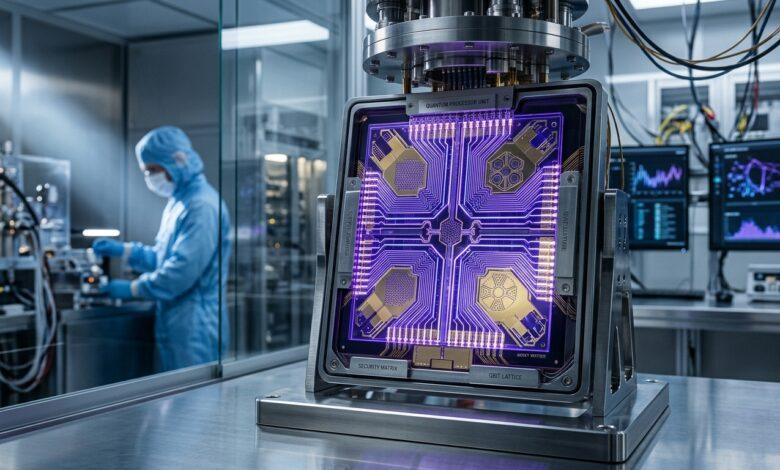
⚡ Quick Answer: Post-Quantum Cryptography Migration Plan
Post-quantum cryptography (PQC) migration is the structured transition from classical public-key algorithms (RSA, ECC) to quantum-resistant lattice-based standards approved by NIST (FIPS 203 ML-KEM and FIPS 204 ML-DSA). Enterprises must implement cryptographic agility now to defend against ‘Harvest Now, Decrypt Later’ (HNDL) state espionage.
For more than three decades, global enterprise security, banking transactions, and internet encryption rested on a shared mathematical foundation: the extreme difficulty of integer factorization (RSA) and discrete logarithms on elliptic curves (ECC). However, the progression of fault-tolerant quantum computing systems threatens to dismantle these cryptographic foundations within the next several years.
With the National Institute of Standards and Technology (NIST) releasing its finalized Federal Information Processing Standards (FIPS 203, 204, and 205), the post-quantum transition has moved from academic debate into mandatory enterprise IT compliance. Security leaders who delay risk leaving sensitive corporate records vulnerable to active adversary interception.
The Immediate Danger: Harvest Now, Decrypt Later (HNDL)
A common misconception among CISOs is that quantum cryptography is an issue for the 2030s when commercial cryptographically relevant quantum computers (CRQCs) come online. This assumption overlooks the active strategy known as Harvest Now, Decrypt Later (HNDL).
Hostile state actors and sophisticated syndicates are actively intercepting and archiving encrypted enterprise network traffic, government communications, patent filings, and healthcare databases today. Once a scalable quantum computer running Shor’s algorithm emerges, this archived data will be decrypted retroactively. If your enterprise data possesses a confidentiality lifespan exceeding five years, it is already exposed.
The Approved Post-Quantum Cryptographic Standards
NIST’s finalized standards establish three primary post-quantum algorithms built upon structured mathematical lattices and hash trees:
- FIPS 203 (ML-KEM / Kyber): The primary standard for Key Encapsulation Mechanisms (KEM). Replaces Diffie-Hellman and ECDH for establishing secure session keys in TLS 1.3, VPNs, and HTTPS connections.
- FIPS 204 (ML-DSA / Dilithium): The primary digital signature algorithm for identity verification, code signing, and certificate authorities.
- FIPS 205 (SLH-DSA / SPHINCS+): A stateless hash-based digital signature algorithm providing a mathematically distinct backup in the unlikely event of a breakthrough against lattice problems.
The 4-Step 2026 Enterprise Migration Roadmap
Phase 1: Automated Cryptographic Inventory (CBOM)
You cannot secure what you cannot see. Security teams must deploy automated binary and network scanners to construct a comprehensive Cryptographic Bill of Materials (CBOM). This identifies every instance of RSA, ECDSA, and Diffie-Hellman across TLS termination endpoints, API gateways, database encryption layers, and third-party SaaS integrations.
Phase 2: Hybrid Key Exchange Deployment
A sudden switch to pure post-quantum algorithms introduces operational risk if a subtle vulnerability is later discovered. Industry best practice in 2026 is deploying hybrid key exchanges (e.g., X25519 combined with ML-KEM-768). In this architecture, data remains protected if either algorithm remains unbroken, providing immediate quantum defense without violating legacy compliance certifications.
Phase 3: Hardware & Network MTU Accommodation
Post-quantum keys and signatures are substantially larger than their classical counterparts. For instance, while an ECDSA public key is approximately 64 bytes, an ML-DSA-65 public key requires 1,952 bytes, and its signature spans 3,293 bytes. Network architects must inspect load balancers, MTU packet sizes, and hardware security modules (HSMs) to prevent packet fragmentation and handshake timeouts.
Phase 4: Cryptographic Agility Architecture
Rather than hardcoding specific algorithms into application business logic, development teams must abstract cryptography behind agile service interfaces. When future standards evolve or key sizes adjust, security architects can rotate cipher suites centrally across API gateways without requiring code rewrites across hundreds of downstream microservices.
Summary Matrix: Classical vs. Post-Quantum Algorithms
| Purpose | Classical Standard (Vulnerable) | Post-Quantum Standard (FIPS 2026) | Key Size Delta |
|---|---|---|---|
| Key Exchange | ECDH / RSA 2048 | ML-KEM (Kyber-768) | ~1.2 KB vs 32 Bytes (Handshake tuning required) |
| Digital Signatures | ECDSA / RSA 4096 | ML-DSA (Dilithium-3) | ~3.3 KB vs 64 Bytes (Certificate chain adjustment) |
| Fallback Signatures | None | SLH-DSA (SPHINCS+) | ~17 KB (Stateless hash tree architecture) |
| Symmetric Ciphers | AES-128 | AES-256 (Quantum resistant via Grover’s algorithm) | Negligible (Standard key length doubling) |
Strategic Takeaway
Post-quantum cryptography migration is an extensive, multi-year infrastructure transition. By cataloging cryptographic assets, activating hybrid TLS handshakes, and building cryptographic agility in 2026, enterprise technology leaders can protect long-term intellectual property and safeguard critical infrastructure against emerging threats.
Related Reading: Check out our detailed guide on Agentic AI Orchestration: How Multi-Agent Systems Are Replacing Rigid Microservices in 2026.
Related Reading: Check out our detailed guide on Navigating Google’s ‘Failed Hostload Exceeded’ Challenge.
Related Reading: Check out our detailed guide on Easy installation and wiring are key advantages of VIPA Profibus connectors.
Related Reading: Check out our detailed guide on What’s the Current Trend in the Sonar System Industry?.
Related Reading: Check out our detailed guide on How did full stack development become the most popular career path?.
Related Reading: Check out our detailed guide on 8 Reasons to Love the Noodles.


